September 11, 2026 · By The Listently Team
How to Interview Someone: A Step-by-Step Guide
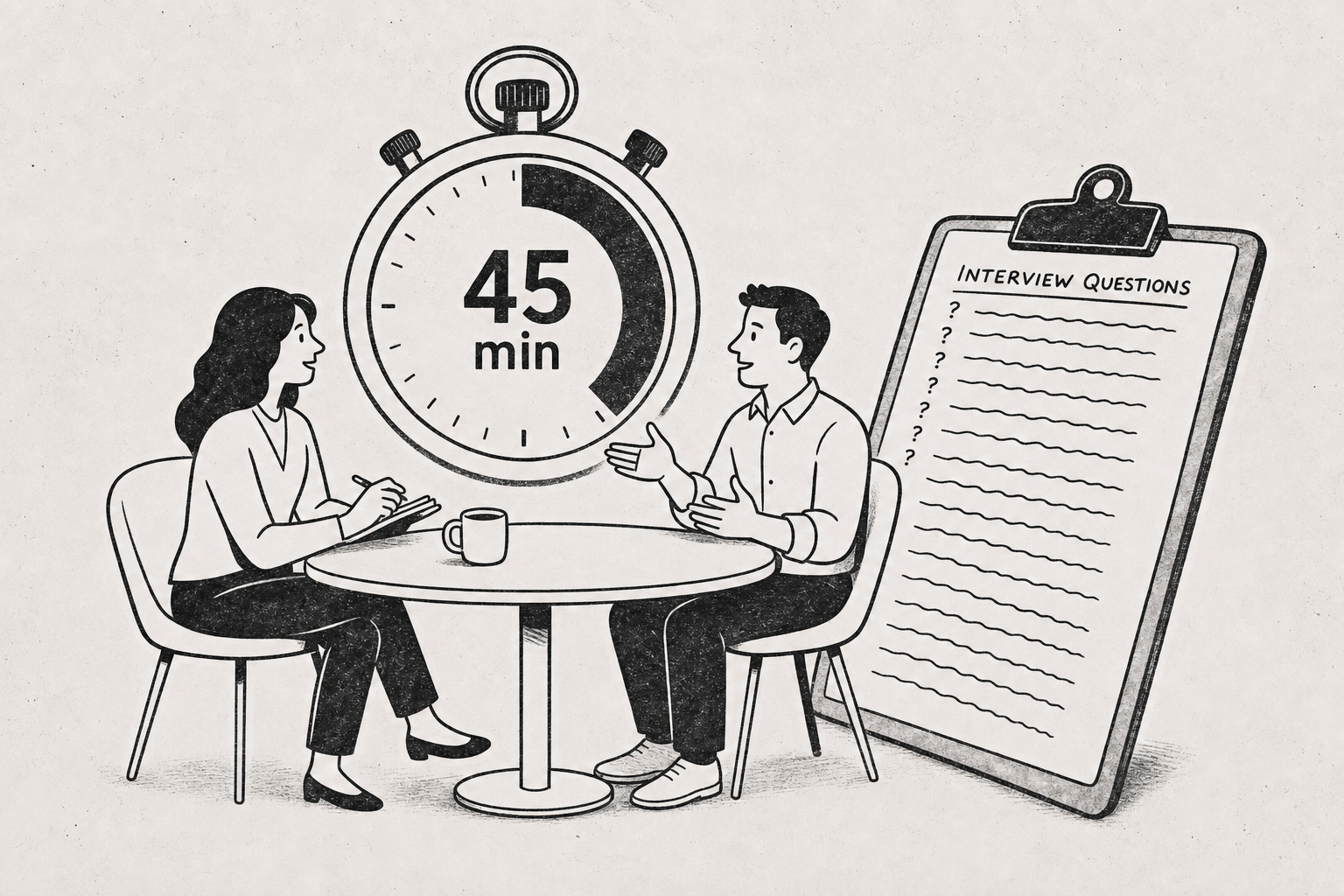
A good interview is mostly decided before it starts. Define one specific objective — the single thing you need to walk away with — then research the subject thoroughly enough that they never have to explain the basics to you. Write roughly twice as many questions as you’ll ask, and sequence them: easy and factual at the start, difficult or sensitive in the middle when trust is highest, reflective at the end. During the interview, treat your question list as a safety net rather than a script; the best material almost always comes from following up on something unexpected. Ask one question at a time, keep them short and open-ended, and let silence do work instead of filling it. Watch for physical signs of discomfort and adjust pace rather than pushing. When a subject is evasive, re-ask the same question in plainer language rather than accusing them of dodging. Close by asking what you missed and confirming how to follow up. Record the conversation if permitted so you can listen instead of scribbling notes.
Start with one objective, not a topic
A topic (“their career,” “the merger”) produces a rambling conversation. An objective produces a usable one.
Write down a single sentence that finishes: After this interview, I will be able to… Explain why the product launch slipped. Describe what the first week after the layoffs actually felt like. Confirm the timeline of who approved what.
If you can’t finish that sentence in one line, you’re not ready to write questions yet — you’re still deciding what the interview is for.
You can have secondary goals, but rank them. When the clock runs short, you’ll know instantly what to drop.
Research until the obvious questions are already answered
The purpose of research is not to show off. It’s to buy you better questions.
Before the interview, find out what your subject has already said publicly on the topic, who else was involved, and what the basic factual timeline is. Anything you could have looked up yourself is a wasted question — and subjects notice.
Useful research outputs:
- A short factual timeline with dates you can reference out loud
- Names and titles of other people involved, spelled correctly
- Two or three direct quotes they’ve given before, so you can push past their standard answer
- One or two specific details that signal you did the work (“you mentioned in the Q3 call that…”)
- A list of what you genuinely don’t know — this becomes the core of your question set
The single best signal of preparation is being able to ask a question that only makes sense if you already understand their situation.
Write twice as many questions as you’ll ask, then sequence them
Draft freely, then cut and order. A 45-minute interview realistically holds 8–12 substantive questions once you account for follow-ups.
A sequence that works for most interviews:
- Warm-up (2–3 minutes). Easy, factual, low-stakes. Role, timeline, how they got involved. The goal is to get them talking in full sentences and to check your recording.
- Foundation. Establish the facts you’ll build on later. What happened, in what order, who was there.
- Core. The questions your objective actually depends on. Put these in the middle third, once rapport exists and before fatigue sets in.
- Sensitive or challenging. Disagreements, contradictions, uncomfortable specifics. Late enough that you’ve earned some trust, early enough that you still have time to handle the fallout.
- Reflection and close. What they’d do differently, what they think happens next, what you failed to ask.
Question craft matters as much as order:
- Ask one question at a time. Double-barrelled questions get half-answered.
- Keep questions shorter than the answers you want. Long questions invite short replies.
- Prefer “walk me through” and “what happened when” over “did you.”
- Save yes/no phrasing for when you specifically need something on the record.
- Ask for examples relentlessly. “Can you give me a specific instance?” converts opinion into evidence.
The fastest way to improve an interview is to shorten your questions and stop asking two things at once.
Active listening means abandoning your list when something better appears
Most weak interviews are technically competent: every prepared question asked, in order, none of them followed up.
Active listening in practice:
- Follow the surprise. If an answer contains something you didn’t expect, ask about that before moving on. It’s the only part of the conversation you couldn’t have predicted.
- Use silence. After an answer ends, wait two or three seconds. Subjects frequently add the most candid part of the answer to fill the gap.
- Reflect back. “So the approval came after the contract was signed?” gives them a chance to correct you and gives you a clean, quotable confirmation.
- Take sparse notes. Write down follow-up prompts and timestamps, not full sentences. Eye contact is worth more than a verbatim record you’ll get anyway from a recording.
- Ask for definitions. If they use jargon, ask what it means in their words. The answer is often more revealing than the term.
Body language tells you when to slow down, not what someone is thinking
Read physical cues as feedback on the conversation, not as lie detection. Crossed arms don’t mean deception; they often just mean cold or bored.
What’s genuinely useful to notice:
| What you see | What it usually means | What to do |
|---|---|---|
| Shorter answers, faster speech | Rushed or feeling cornered | Slow your own pace; ask an easier question |
| Long pauses before answering | Genuinely thinking, or choosing words carefully | Wait. Don’t rescue them |
| Breaking eye contact and shifting | Discomfort with the topic | Acknowledge it: “We can come back to this” |
| Leaning in, gesturing more | Engaged, on a subject they care about | Stay here longer than planned |
| Repeatedly checking the time | You’re near the end of their attention | Jump to your highest-priority remaining question |
Treat cues as a signal to change your behaviour, not as evidence about theirs.
Also read your own: if you’re leaning forward, interrupting, or nodding constantly, you’re likely talking too much.
Handling a nervous subject: lower the stakes explicitly
Nervous subjects give short, cautious, over-rehearsed answers. The fix is structural, not motivational.
- Tell them at the start how the material will be used, who will see it, and whether they’ll get to review quotes. Uncertainty is most of the anxiety.
- Say out loud that they can pause, skip a question, or restart an answer. Explicitly permitting a restart is the single most effective way to get a nervous person to speak naturally.
- Start with logistics and chronology. Facts are easier to answer than feelings.
- Don’t open with the hardest question just to “get it out of the way.”
- Mirror their register. If they’re formal, don’t be jokey; if they’re casual, don’t interrogate.
Handling an evasive subject: re-ask, don’t accuse
Evasion usually looks like answering a nearby question instead of yours, retreating into abstraction, or delivering a prepared talking point.
A workable escalation:
- Re-ask more simply. “Sorry — just to be clear: did the board vote on it?” Often they simply didn’t hear the question you thought you asked.
- Narrow it. Replace the broad question with a specific, checkable one. Dates, counts, names.
- Name the gap neutrally. “I want to make sure I represent this right — I still don’t have an answer on who approved the change.”
- Offer the alternative. “Is it that you don’t know, or that you can’t say?” This distinction is itself informative and is usually answered honestly.
- Park it and return. Move on, then come back later in different words. Resistance often softens once the conversation is flowing.
Persistence works; hostility doesn’t. Frame repetition as your need for accuracy rather than their failure to answer.
If they genuinely won’t answer, note the refusal precisely. “Declined to say who approved it” is a legitimate finding.
Wrap up with three questions and a logistics check
End deliberately. The last two minutes reliably produce useful material if you use them.
- “What did I not ask that I should have?” Subjects know their own story better than you do.
- “Who else should I talk to?” Free sourcing, and a warm introduction if you ask for one.
- “Is there anything you want to add or correct?” Catches misstatements before they become your problem.
Then handle logistics: confirm name spellings and job title, agree on what’s on the record, and establish how you’ll follow up with fact-checking questions.
A note on recording
Recording lets you listen properly instead of transcribing in real time, which is the main reason to do it.
Recording-consent rules vary by jurisdiction — some places require all parties to consent, others only one — so confirm the requirements where you and your subject are located, and ask permission on the recording at the start regardless. It takes ten seconds and settles the question permanently.
For quality, a quiet room and a close microphone matter more than expensive gear; if you plan to transcribe afterwards, it’s worth reading up on how to improve transcription accuracy before you record. Once the interview is done, uploading the audio to Listently gives you a speaker-labeled transcript and a summary in minutes, so you can go straight to pulling quotes instead of retyping the conversation.
Common questions
How long should an interview be? Plan 45 minutes for most subjects and treat anything past 60 as bonus. Attention and answer quality both drop noticeably after an hour, and you’ll get more from a focused 40 minutes than a meandering 90.
Should I send questions in advance? Send themes, not the exact question list. Themes help unprepared or nervous subjects; a full script invites rehearsed answers and closes off follow-ups.
What if I run out of questions early? Ask for examples of something they already said, or ask them to explain a term they used. “Can you give me a specific example of that?” almost never fails to produce new material.
How do I handle a subject who talks too much? Interrupt politely at a natural pause and redirect with a specific question. “That’s useful — can I bring you back to the timeline?” is enough, and most subjects welcome the structure.