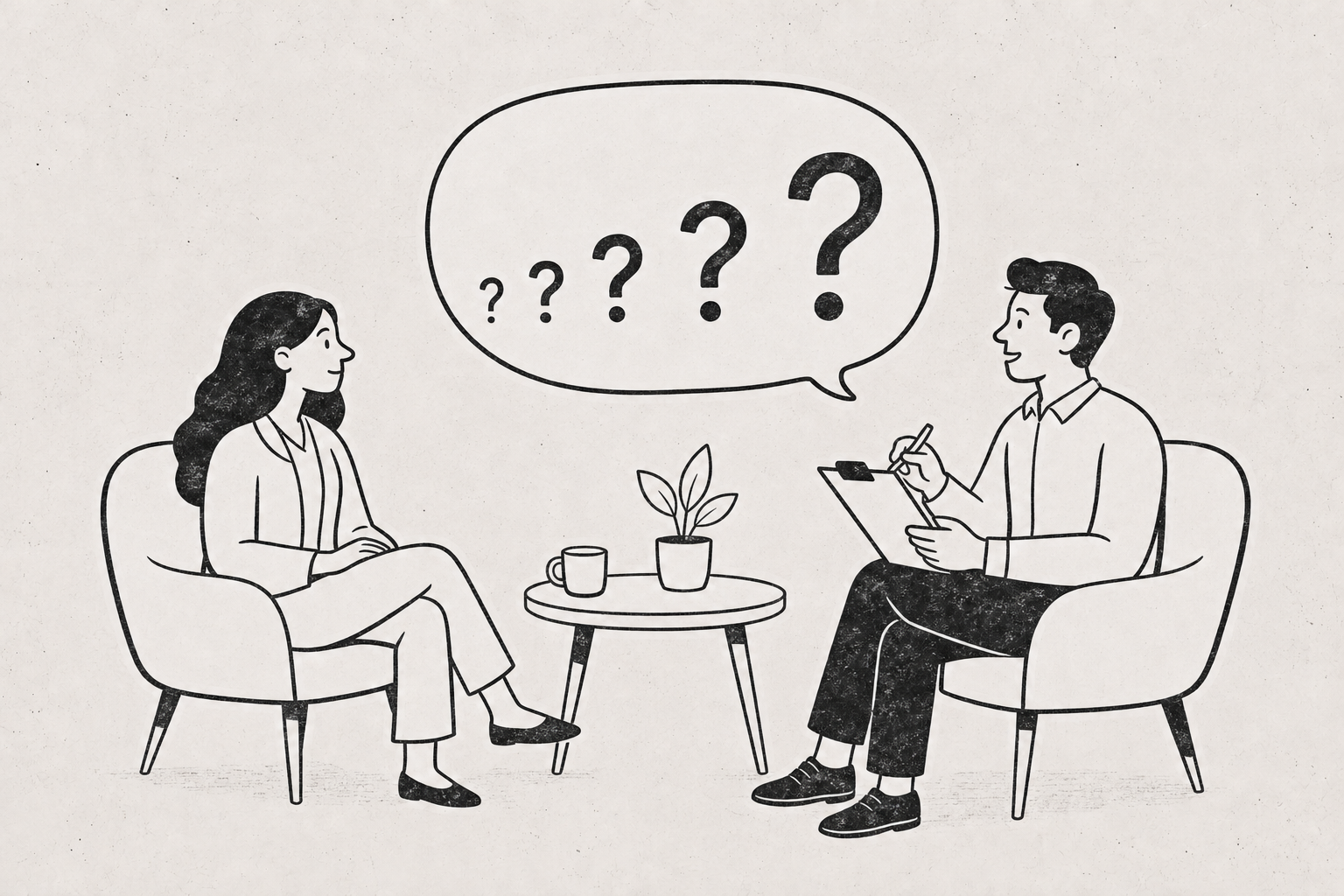
There are five question types that do almost all the work in an interview: open-ended questions that invite a long answer (“Walk me through how your team handles escalations”), closed questions that confirm a single fact (“How many people are on that team?”), probing questions that dig into something already said (“You said that was frustrating — what specifically made it frustrating?”), hypothetical questions that test reasoning against a situation that hasn’t happened (“If the budget were cut in half, what would you drop first?”), and behavioral questions that ask about something that actually did happen (“Tell me about a time a launch slipped — what did you do?”). Each does a different job, and the common mistake is using one type for a job another type handles better. The sequence matters as much as the mix: open the conversation with broad open-ended questions, use closed questions to anchor facts, probe wherever an answer is vague or interesting, and save hypotheticals and sensitive behavioral questions for the middle-to-late stretch when the person has warmed up. A good interview is mostly open-ended and probing, with closed questions used sparingly.
Open-ended questions get you material; closed questions get you facts
Open-ended questions can’t be answered with yes, no, or a number. They hand control of the answer to the person you’re interviewing, which is exactly what you want when you don’t yet know what the interesting part of the story is.
Examples:
- “Walk me through a typical Tuesday on your team.”
- “What’s changed about how you do this in the last year?”
- “How did you end up working on this project?”
- “What surprised you most about the rollout?”
Closed questions do the opposite. They narrow to a single verifiable answer: a date, a number, a yes/no, a name. “Did you report that to your manager?” “How long did the migration take?” “Were you in the room for that decision?”
Open-ended questions are for discovery; closed questions are for confirmation — and if you lead with closed questions, you’ll end up with a dataset instead of a conversation. The failure mode is interviewing from a checklist of closed items and never finding out the thing you didn’t know to ask about.
One closed-question trap worth naming: the question that’s secretly leading. “So that was frustrating, right?” isn’t a closed question, it’s a suggestion. Ask “How did that feel?” or “What was that like?” and let the person pick the word.
Probing questions are where the actual interview happens
Probing questions follow an answer rather than coming off your list. They’re how you turn a surface answer into something usable. Most interviewers underuse them because the prepared question list feels like the plan, and following up feels like going off-script.
Useful probes, roughly in order of how aggressive they are:
| Probe type | Example | When to use |
|---|---|---|
| Silence | (say nothing for 3–4 seconds) | After an answer that sounded incomplete |
| Echo | “Unmanageable?” | To get a definition of a vague word |
| Elaboration | “Can you say more about that?” | When the answer was short but on-topic |
| Example | “What’s a specific instance of that?” | When the answer was abstract |
| Clarification | “When you say ‘the team,’ who do you mean?” | Ambiguous reference |
| Contrast | “How was that different from before?” | To establish cause or change |
| Challenge | “That seems to cut against what you said earlier — help me square those.” | Late in the interview, carefully |
Silence is the most underrated probe: most people fill a three-second pause with the part of the answer they were deciding whether to say. Resist the urge to jump in with your next question the moment they stop talking.
Probing is also the reason you want the recording. You can’t simultaneously listen closely enough to formulate a good follow-up and take complete notes. Recording and transcribing afterward frees your attention for the follow-up. If you’re new to running interviews end to end, our step-by-step guide to interviewing someone covers the logistics around the questions.
Behavioral questions ask what happened; hypothetical questions ask what would
Behavioral questions are anchored to real past events: “Tell me about a time when…” “Describe the last time you had to…” “What did you actually do when…” They work because past behavior is evidence, and because it’s much harder to produce a convincing fake specific than a convincing fake principle.
Hypothetical questions describe a situation and ask for reasoning: “Suppose two of your biggest clients ask for conflicting features in the same week. How do you decide?” They test judgment, priorities, and how someone frames a problem — but they measure what a person believes they would do, which is often not what they do.
A practical split:
- Use behavioral questions when you want evidence of capability or to reconstruct what actually happened. Hiring, incident reviews, exit interviews, user research about real workflows.
- Use hypothetical questions when the situation genuinely hasn’t occurred yet — product concept testing, planning conversations, probing values and tradeoffs.
- Follow every hypothetical with a behavioral chaser. “Has anything close to that come up before? What happened?” The gap between the two answers is frequently the most informative thing in the interview.
If you only have room for one of the two, ask behavioral — hypotheticals are easy to answer well and hard to answer truthfully.
For behavioral answers, probe for the parts people skip: what the situation actually was, what they specifically did versus what the team did, and what the outcome was. Answers that stay in the first-person plural (“we decided,” “we shipped”) usually need a “What was your part in that?” probe.
Sequence: broad to narrow, easy to hard, facts last
Question type matters less than order. A good interview has a shape:
- Warm-up (2–3 minutes). Easy, factual, low-stakes. “How long have you been in this role?” Closed questions are fine here — you’re establishing rhythm, not gathering data.
- Broad open-ended. One or two large questions that let the person set the terms. “Walk me through how this works today.” Listen for the threads you’ll want to pull.
- Probe the threads. This is the bulk of the interview. Follow what’s interesting rather than what’s next on the page.
- Targeted behavioral questions. Now that there’s context and rapport, ask about specific episodes, including difficult ones.
- Hypotheticals and tradeoffs. Forward-looking questions land better once you share a factual baseline.
- Cleanup closed questions. Dates, numbers, spellings, titles. Batch them at the end so they don’t interrupt the flow earlier.
- The catch-all. “What should I have asked you that I didn’t?” It reliably produces something.
Sensitive questions go in the second half, never the first five minutes — people answer them more honestly after they’ve already talked for twenty minutes without being judged.
One more sequencing rule: don’t ask two questions in one breath. “How did the rollout go, and were you happy with the timeline?” gets you an answer to whichever half is easier.
Match the question mix to the interview type
The right ratio shifts depending on what you’re doing.
- Job interviews: heavy on behavioral, light on hypothetical, closed questions only for logistics. Probing is what separates a useful hire signal from a rehearsed answer.
- User research: almost entirely open-ended and probing, anchored to past behavior. Avoid hypotheticals about whether someone would use a feature — the answers are famously unreliable.
- Journalism and podcasts: open-ended to get material, probing to get the quote, closed questions at the end for fact-checking names and figures.
- Exit interviews: open-ended first, behavioral second, and expect the most candid material to come after the halfway mark.
- Sales discovery: open-ended to find the problem, probing to size it, closed to confirm budget, timeline, and decision-makers.
The one constant across all of them: if your question list is more than half closed questions, you’ve written a survey, not an interview.
Review the transcript to audit your own questions
The fastest way to improve as an interviewer is to read back what you actually asked, not what you meant to ask. In a transcript, your own questions are visible as text, and the patterns show up immediately: leading phrasing, double-barreled questions, follow-ups you didn’t ask, moments where you interrupted a pause that was about to produce something.
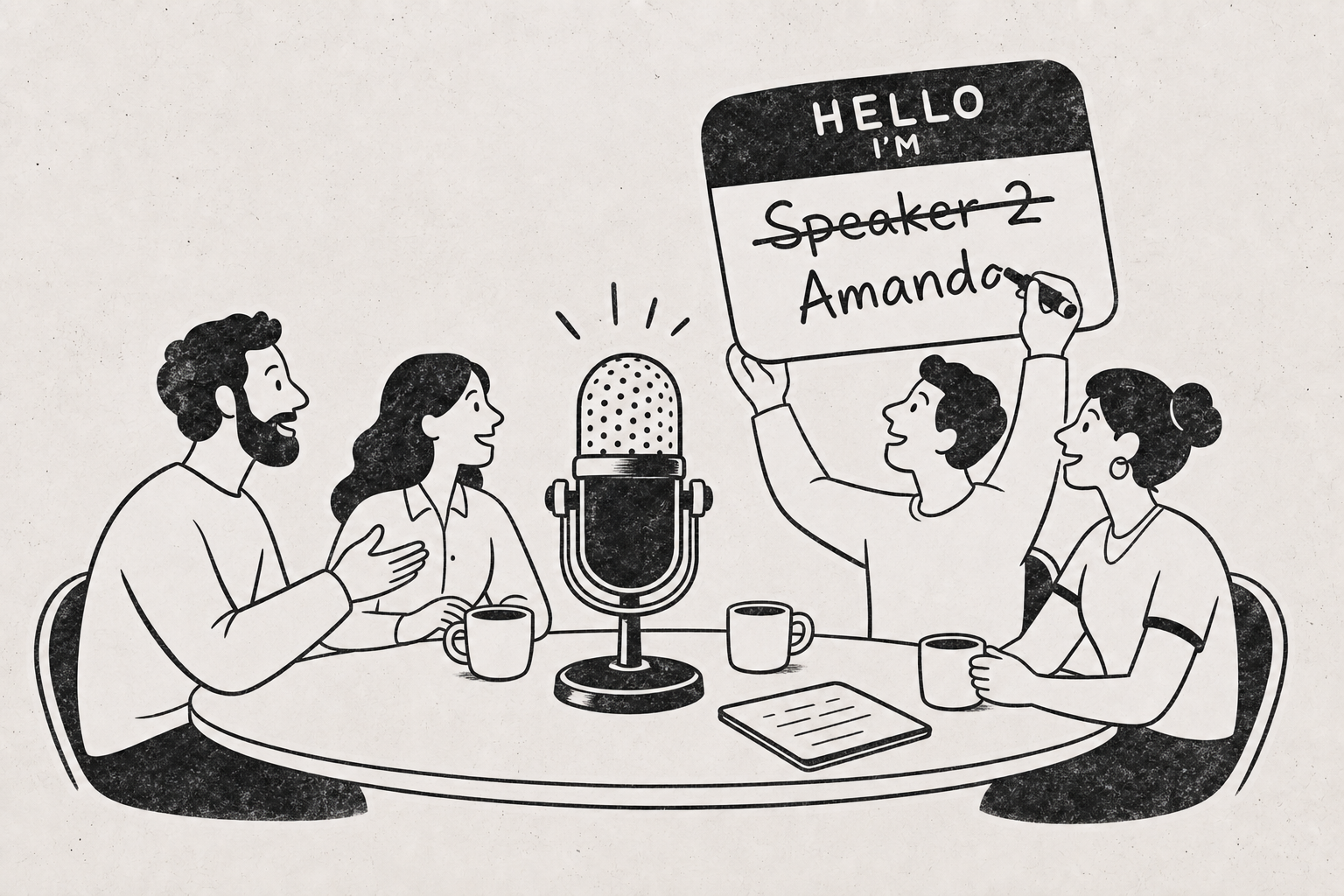
Listently produces speaker-labeled transcripts from uploaded audio or video, and you can rename the speakers to real names so it’s obvious which lines are yours. Reading your own lines in isolation is an uncomfortable but effective exercise. If you want to go further, highlighting the questions that produced the best answers builds a reusable question bank over time — our post on annotating transcripts with colors and comments covers that workflow.
A note before you record anyone: recording-consent rules vary by jurisdiction, and some places require all parties to agree rather than just one. Ask on the record at the start of the conversation, and get written confirmation where your context calls for it.
Common questions
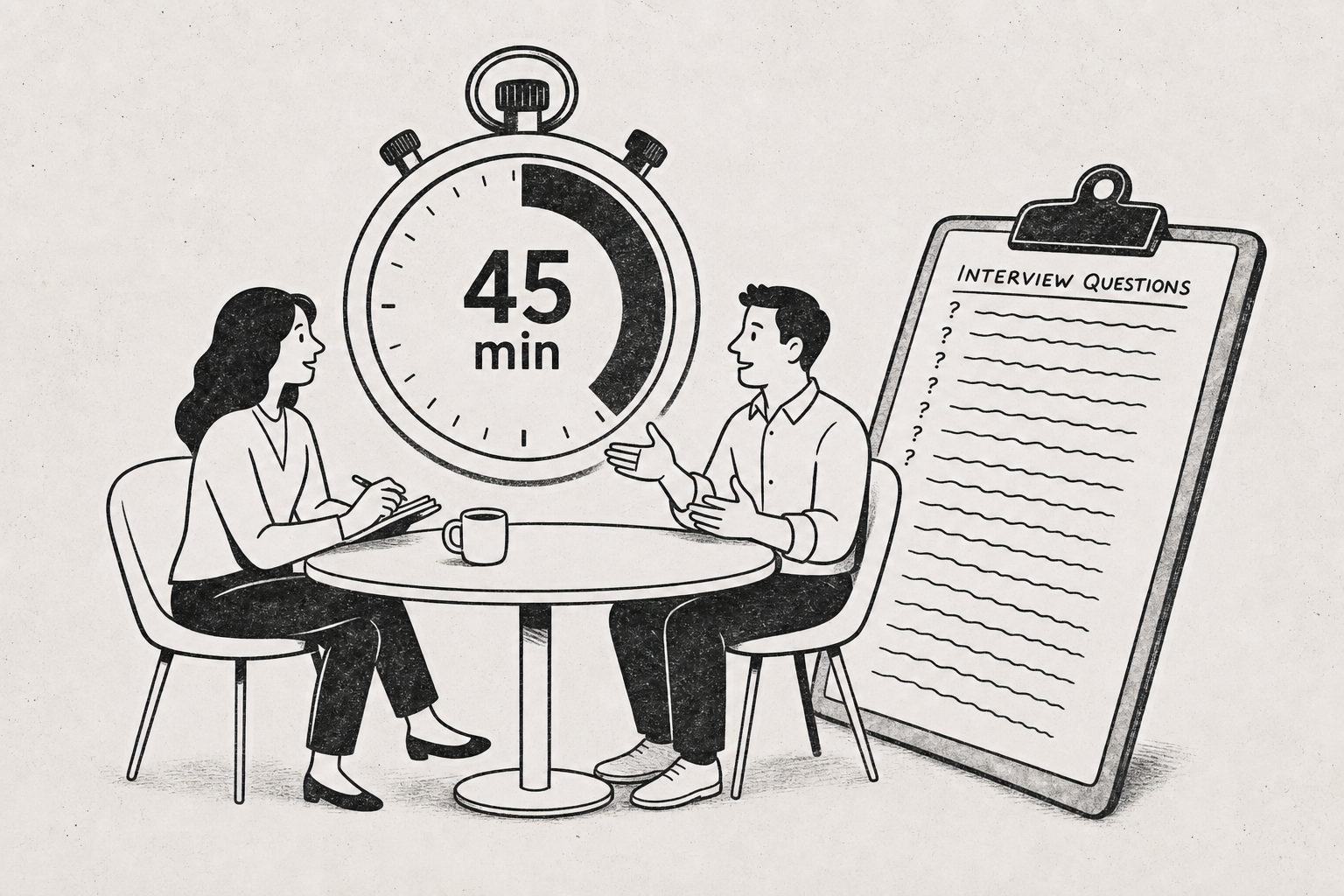
How many questions should I prepare? Prepare 6–10, expect to ask 4–6 of them, and plan to spend most of the time on follow-ups you didn’t write down. A long list encourages you to march through it instead of listening.
Are leading questions ever acceptable? Rarely, and only to confirm something the person already said in their own words (“So the delay came from procurement, not engineering?”). Never use one to introduce a framing they haven’t offered.
What’s the difference between a probing question and an interrogation? Intent and pacing. Probing follows curiosity about what they said; interrogation tests a theory you arrived with. If you’ve asked three challenging follow-ups in a row, move on and come back later.
Should I send questions in advance? Send themes, not the exact list. Themes let people gather documents and recall examples; exact questions produce rehearsed answers and kill the follow-up.
Record the conversation, transcribe it, and read your own questions back — try Listently free and see what your interviews actually sound like.