August 22, 2026 · By The Listently Team
Does Transcription Software Train AI on Your Audio?
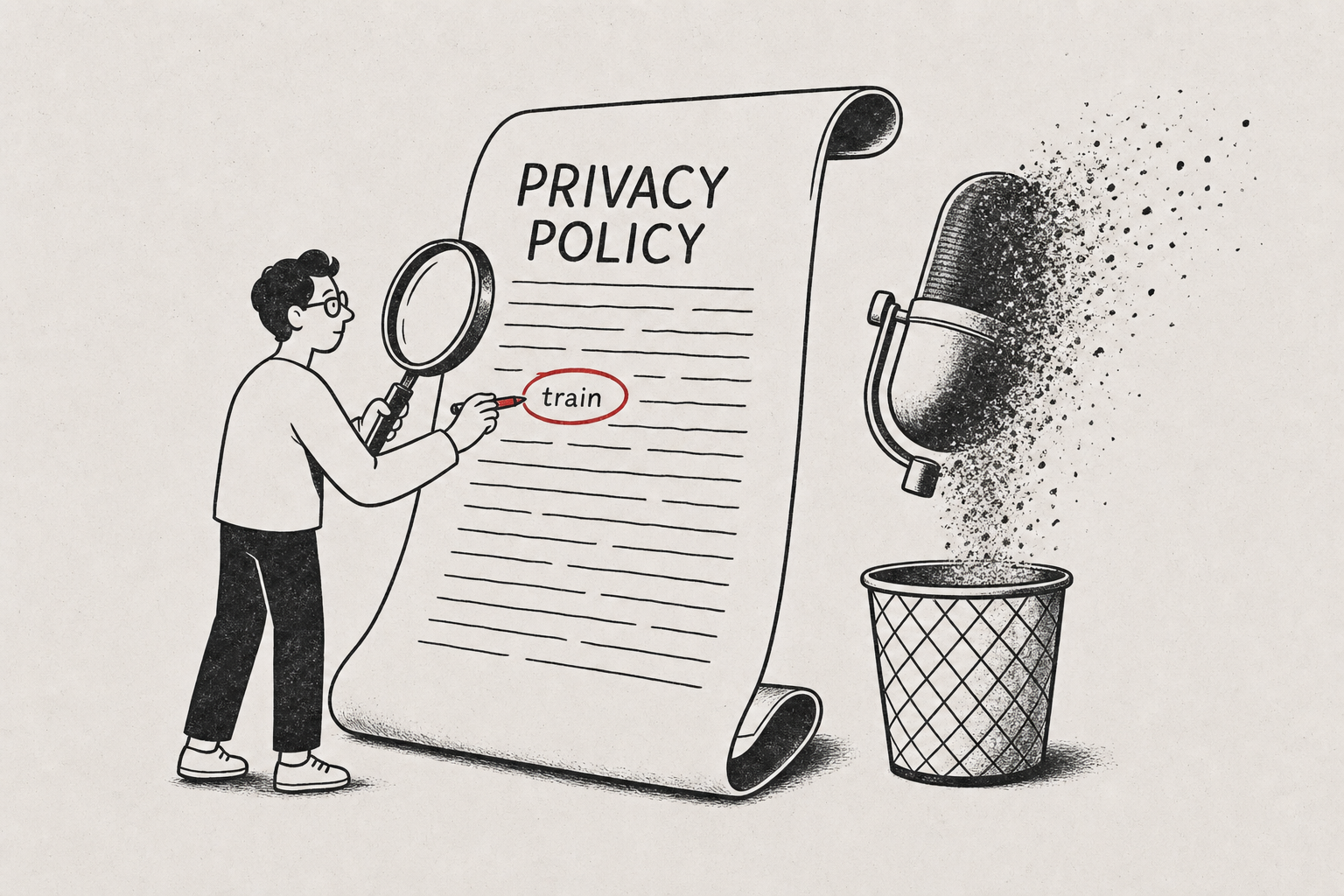
Some transcription services do use your uploaded audio to train or improve AI models, and some don’t — it depends entirely on the vendor, and the answer is almost always buried in the terms of service rather than stated on the pricing page. The three things that actually determine your exposure are: whether the provider grants itself a license to use your content for model training or “service improvement,” whether it shares audio and transcripts with third-party processors or subprocessors, and how long it retains your files after the transcript is generated. A vendor can be fine on one of these and bad on the other two. Look for explicit, unambiguous language — “we do not use customer content to train models” — rather than soft phrasing like “we may use aggregated data to improve our services,” which usually means yes. Also check retention: a policy that says files are kept for 30 days by default is a very different risk profile from one that deletes audio immediately after processing. Listently’s position on all three is: never used for training, never shared with third parties, and uploaded audio deleted immediately after processing.
The short answer: it depends on the vendor, and the default is often “yes”
There is no industry standard here. Transcription is an AI product category, and audio is the exact raw material those models need, so the incentive to retain and reuse customer uploads is structural, not accidental.
Free tiers are where this shows up most often. If a service gives away substantial transcription minutes at no cost, the data is frequently part of the exchange, even when that’s not spelled out prominently. That’s not automatically disqualifying — plenty of free tiers are just marketing — but it’s the first place to check the terms rather than assume.
Assume a transcription vendor may use your audio for training unless its policy explicitly says it doesn’t. Silence in a privacy policy is not a “no.”
The three clauses that actually matter in a data policy
Most privacy policies are long. You only need to find three things. Search the document (Ctrl+F) for the terms in the right-hand column below.
| What to check | Why it matters | Search for |
|---|---|---|
| Training / model improvement | Determines if your recordings become permanent training data | “train”, “improve”, “machine learning”, “aggregate” |
| Third-party sharing | Even if the vendor doesn’t train, its subprocessors might | “third party”, “subprocessor”, “service provider”, “affiliates” |
| Retention & deletion | How long a breach or subpoena could reach your files | “retain”, “delete”, “storage period”, “days” |
1. Training use: look for an explicit negative, not a vague positive
The clause you want reads something like “we do not use customer audio or transcripts to train any model.” The clause that should concern you reads “we may use content to develop, improve, and provide our services.”
That second phrasing is broad enough to cover model training, and it’s the industry default because it’s legally convenient. Some vendors offer an opt-out toggle in account settings — useful, but note that an opt-out means the default is opt-in, and defaults apply to anyone who never reads the settings page.
A per-account opt-out is weaker than a company-wide policy of never training on customer data, because opt-outs can be reset, missed, or scoped narrowly to one product line.
2. Third-party sharing: check the subprocessor list, not just the promise
Plenty of transcription tools are thin wrappers around a third-party speech-to-text API. In that architecture, your audio leaves the vendor’s infrastructure by design, and the vendor’s own privacy promises don’t automatically bind whoever is downstream.
Look for a published subprocessor list. If one exists, read what each entity does. If none exists and the policy uses phrasing like “trusted partners” without naming them, you can’t actually evaluate the risk.
Also watch for the acquisition clause — most policies allow customer data to transfer in a merger or sale. That’s near-universal and hard to avoid, but it’s another argument for minimizing how long your files sit on someone else’s servers.
3. Retention: “how long” is the question, “immediately” is the best answer
Retention is the most concrete of the three, because it’s measurable. Common patterns:
- Indefinite — files stay until you manually delete them. Highest exposure.
- Fixed window — 7, 30, or 90 days. Standard, and usually fine for low-sensitivity content.
- Configurable — you set the policy, often only on higher tiers.
- Immediate post-processing deletion — audio is discarded once the transcript exists. Lowest exposure.
The distinction that trips people up: deleting the audio is not the same as deleting the transcript. A transcript you can still open in your account obviously still exists. The meaningful question is whether the original recording — the voice data, the thing that’s biometrically identifiable and useful for training — persists after it has served its purpose.
Ask specifically about audio retention, separately from transcript retention. Vendors that conflate the two in their policy usually keep both.
Why this matters more for some recordings than others
Not every transcription job carries the same weight. A conference talk you’re going to publish anyway is different from a candidate interview or a therapy intake session.
Higher-sensitivity categories worth extra scrutiny:
- Anything under a confidentiality agreement — client calls, vendor negotiations, board discussions. An NDA you signed may prohibit uploading the recording to a service that retains it.
- Journalism with confidential sources — retention windows are the practical exposure here, since retained files can be subpoenaed.
- Health, legal, or financial conversations — often subject to sector-specific rules that go beyond general privacy law.
- Research interviews — ethics board approvals frequently specify how and where recordings may be processed and stored.
- Internal HR matters — investigations, performance discussions, exit interviews.
For any of these, the vendor’s answer to the three clauses above should be checked before the first upload, not after. Tools like Listently that delete the source audio immediately after processing reduce the retention question to something close to zero, but that only helps if you’ve confirmed the training and sharing answers too.
A note on recording consent
Data policy and recording legality are separate problems, and clearing one doesn’t clear the other. Recording-consent rules vary by jurisdiction — some places require only one party to consent, others require everyone on the call, and some sectors have their own additional requirements.
Get consent before you record, and note it at the top of the recording. If you’re transcribing interviews, our practical guide to transcribing interviews covers the workflow side of this in more detail.
How Listently answers each of the three questions
Here’s the direct answer to each checklist item, with no hedging:
| Question | Listently |
|---|---|
| Is audio used to train AI models? | No — audio and transcripts are never used to train any AI model |
| Is data shared with third parties? | No — never shared with third parties |
| How long is audio retained? | Uploaded audio is deleted immediately after processing |
The AI summary is generated from the actual transcript text and attributes points to specific speakers, and it’s instructed not to invent action items or conclusions that aren’t in the recording. Speaker labels are automatic and renameable — rename a speaker once and it updates everywhere, including in the summary. Transcripts stay editable after transcription completes.
Practical details for evaluating fit: Listently handles MP3, WAV, M4A, FLAC, OGG, MP4, MOV, and MKV, supports over 100 languages, and exports to Word, PDF, and SRT/VTT. The free plan covers 3 transcriptions a day at up to 30 minutes per file with 2GB uploads. Pro is $8.99/mo billed annually or $13.99/mo billed monthly, with unlimited transcriptions, no file-length limit, and 5GB uploads.
If you’re comparing options on privacy alongside features and price, our comparison of Listently, TurboScribe, and Otter.ai covers the feature side.
A checklist you can run in five minutes
Before uploading anything sensitive to a transcription tool:
- Find the privacy policy and search for “train” — is there an explicit “we do not”?
- Search for “third party” and “subprocessor” — is there a named list?
- Search for “retain” and “delete” — is audio retention stated separately from transcript retention?
- Check whether any privacy protection is tier-gated (some vendors reserve stronger terms for enterprise plans)
- Confirm you have consent from everyone on the recording under the rules that apply where you are
- Check whether an NDA or ethics approval restricts third-party processing of this specific recording
If a vendor can’t answer the first three items from its public documentation, that’s the answer.
You can try Listently free — the free plan runs on the same policy as Pro: no training on your audio, no third-party sharing, audio deleted immediately after processing.
Common questions
What happens to my uploaded audio after the transcript is ready? Policies differ by vendor, so check before you sign up rather than after. With Listently, uploaded audio is deleted immediately after processing, so the source recording isn’t sitting in storage waiting for a breach, a subpoena, or a change of ownership.
Is a free transcription plan automatically worse for privacy? Not automatically, but it’s the most common place to find training-data clauses, because free access has to be paid for somehow. Read the terms rather than inferring from price. Listently’s free plan is limited by volume — 3 transcriptions per day, 30 minutes per file — not by weaker privacy terms.
Should I keep my own copy of the original recording? Yes. With any vendor that deletes source audio immediately after processing, including Listently, the uploaded file is gone once the transcript exists — so your own archive is the only copy of the raw recording. That’s the tradeoff of immediate deletion, and it’s worth planning for before you upload. On the transcript side, Listently transcripts and speaker names are editable after transcription completes.
Does “we don’t sell your data” mean the same as “we don’t train on it”? No. Selling and training are separate activities, and a policy can truthfully claim the first while doing the second. Look for language that addresses training specifically.